Showing posts with label chicks. Show all posts

Wednesday, March 12, 2025

Family of Western Grebes and Their Babies


On the Bear River MBR, July, 2024


A few days ago while editing the photos of Western Grebes, I found myself again on the banks of the Bear River, as if I were once again observing and photographing this family.

The parents had a very difficult time ahead: they would feed and raise their babies without rest for 2-3 months, since they were still very small at first and depended on adults for warmth and food.


Generally, life is good.


Friday, July 5, 2024

Western Grebe and Her Baby


Finding a natural blind on the Bear River MBR is not that easy, but there are a couple of places that can hide you partially and the rest is to be patient and wait.

That morning, not paying attention to my hiding place the Western Grebe swam close to the shore and kindly allowed to photograph her and her baby.


Generally, life is good.


Monday, September 18, 2023

Busy Parents


In July, Western Grebes were busy raising their chicks, feeding them and riding the young on their backs.  

Now, the Grebes  have begun to prepare for their night migration.  The young have matured and have grown new flight feathers, they became independent and strong.


Generally, life is good.


Tuesday, August 1, 2023

Western Grebes Feeding Their Chick


As I write this, the Bear River Migratory Bird Refuge hosts now quiet a few families of Western Grebes.  The parents are busy raising their chicks, feeding them and riding the young on their backs.  

This time, the parent has caught a small fish and watching closely to see if the chick can swallow it.


The parent will always stay with the chick until he is sure that the chick has not dropped a slippery fish into the water.  


This time the feeding went smoothly and the parents are happy, but a few minutes later the parent is back on the hunt for fish to deliver it to the chick. It's never ending job for adult Western Grebes to keep their chicks fed.

Generally, life is good.


Friday, July 21, 2023

American Coot Parents and Their Chicks


American Coot chicks have already matured and are independent.  It happened so fast that it's hard to believe that just a few weeks ago the parents were taking care of the young feeding them incessantly.


I recently learned why Coot chicks are red.  It's interesting that Coots mothers add pigments to their yolks.  The more eggs mother lays the more pigment she adds.  In this way she effectively paints her chicks by order of age. 


The bond between parents and chicks is very strong.  There was so much tender care and love in the air.


Diving incessantly for food is quiet tiring, but soon the chicks will become independent and parents will be free again.


Generally, life is good.


Saturday, July 15, 2023

Female Pied-billed Grebe with Her Baby


During my last trip to the Bear River MBR I was over the moon when I spotted a female Pied-billed Grebe with her baby.  

Look at its colors! The baby's face is stripped white and orange.  Who would have thought that bright orange spots are part of natural camouflage.


It's very tiring to feed a baby all the time, so the mother sometimes took a short break and went about her usual business, stretching, preening or just relaxing.


While mother was preening the baby decided to stretch and shake off the excess water.  Suddenly it has became a little bigger and looked stronger but the baby's wings were still tiny and weak.


Exploring the swamp on your own is fun and why not get daring for a little while?

Generally, life is good.


Tuesday, June 27, 2023

Female American Coot is Feeding Her Chick


It was a big surprise to stumble upon the Coot family.  The chicks looked so funny with their yellow-orange downy feathers, bare red and black head and stubby red and orange bill.  

Some Coot chicks were more independent but the chick in the photo above couldn't yet feed itself and was fed by its mother.


Opps,  the chick dropped its food. 


Mother immediately dived into the water and emerged from it with algae. The chick  was obviously looking forward to being fed again.


American Coots are omnivores, they eat seeds of marsh weeds, grasses, algae, fish, worms, snails and eggs of other birds.


Life goes on.


Tuesday, June 20, 2023

Female American Avocet Protects Her Chicks from the Wind - I.


Tomorrow will be the first day of summer in Utah but early this morning a stormy cold wind with rain raged over the Bear River MBR.

My trip was coming to the end when I came across the Female American Avocet who tried to keep her chicks dry and warm under her feathers protecting them from wind and rain.  

Af first, only one chick was hiding under the mother's feathers, but soon another appeared and was eager to join this sibling.


The chick is in no hurry, trying to figure out how to squeeze under mother's feathers.


It's probably more convenient to start right from the center.


The chick is slowly goes down.


The young is almost under the mother's feathers and is trying to get comfortable.


The mother patiently stood in one spot for almost half an hour until her chicks got out and began to look for food.

It was a true motherly love, tender and caring.

Life goes on.


Saturday, June 10, 2023

Young Black-necked Stilts Learning to be Independent


Just a couple days ago I was photographing a nesting female Black-necked Stilt  and this morning I was excited to learn that four chicks hatched.   

When these chicks were born they were able to walk from their nest scrape just 1-2 hours after hatching. 


About five weeks, the chicks will make their first flight.  In the meantime, they are learning how to be independent.

Not only chicks can walk after hatching, they can run and swim as soon their down is dry, which usually happens within 24 hours after hatching.


The Black-necked Stilts live approximately 20 years.  First year will be the hardest  and I hope that al the chicks will survive and will be healthy and strong.

Life goes on.


Wednesday, May 17, 2023

In the Great Blue Herons' Rookery - II.


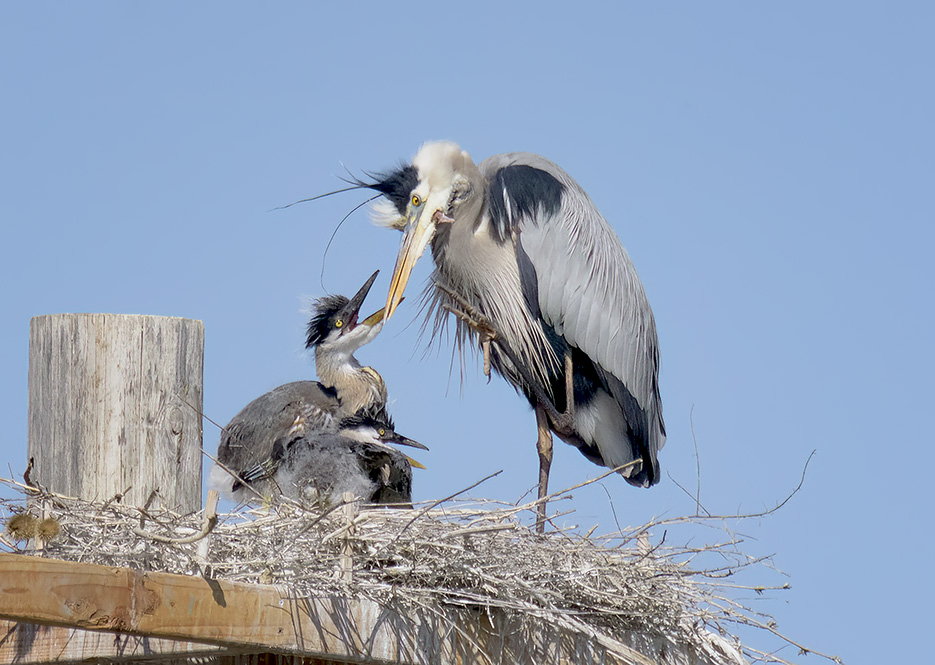
Raising Great Blue Herons' chicks is incredibly difficult. They can be brutal toward their parents and often attack them while they are fed. The chicks also can be violent towards their siblings hurting them in a fight for food. 

Later on, the juvenile Herons become so aggressive that their parents quickly drop a fish and leave.


At this age, the smallest chicks don't get enough of food and the largest ones are the most aggressive.  You can see the chick clutching its mother's beak demanding to be fed.


Finally, the exausted mother broke away from the aggressive chick. She needed some rest.


It seemed that everything was quiet for a few minutes, but the rest was short,  and the aggressive chick tried again to grab its mother's beak hoping to get food.


Enough!  I am taking a little time for myself before I go away for fishing.

Mother broke away from her chicks and started to preen.  She suddenly became tall and her beak became unreachable.

Life goes on. 


Monday, May 8, 2023

Female Great Blue Heron and Her Four Babies


Yesterday I visited the Great Blue Herons rookery again and this time it looked differently.  Two nesting sites were abandoned and one nest was not completed  and a lone Heron stood on it. 

What's happened?  Why did some Herons leave their nests?  I wish I had answers...

Even though I was sad I was happy that most of Great Blue Herons had already babies.


This Heron family has four chicks that are two weeks old and will stay in the nest for 41 to 81 days, being fed and cared by their parents.


Let's see what is going on under our nest.


Looking down the chick tries to balance raising its small, undeveloped wings.  This chick was the bravest of the whole brood. 

Life goes on.